Showing posts with label garden design. Show all posts

Sunday, 21 March 2010

Planting New Ways

I've been keeping an interested eye over the past year on a unique (for the moment) planting scheme behind the new glass house at the RHS Garden at Wisley. Different, because there is no planting plan to speak of, interested because 'What? No planting plan? I'm going to go out of business!' There is actually no plan in terms of 'this plant here, that plant there'. Instead the planning is the choice of seed mix. (Yes, seeds, remember them?) James Hitchmough of Sheffield University has been busy for many years developing reliable mixes of perennial plants that can be grown as an annual meadow. The results are nothing less than spectacular. All the plants were apparently transported to the site in Prof. Hitchmough's pocket. With some basic ground preparation and little to no maintenance, a remarkable planting scheme has taken shape. By creating layers of plants, i.e. mostly ground cover, with some medium high 'pretties' and a few taller species with bare stems, a fully structured scheme, without the taller varieties shading the lower ones, is created. From spring into late summer a constantly changing array of beautiful and natural looking (but mostly N American prairie) plants come into flower, so that the area is constantly changing, evolving through the seasons. Even in Autumn you have the structure of the dying stems. Possibly the closest thing to 'all year round interest', an over used (and nearly always impossible) phrase I run into over and over again. I predict, and hope, that this sort of scheme will begin to infiltrate our public spaces and push out the hideous, high maintenance, expensive displays of routine bedding plants that blight roundabouts and parks country wide (this might be a personal view, but luckily for me, I'm right). If we could bring back perennials to these places, local authorities would not only save money but much larger areas could be planted, rather that a few square meters of neon primroses. Sorry to swear, but primroses... Why?
(To be fair to annuals, Prof. Hitchmough's colleague at Sheffield, Dr. Nigel Dunnett, has been doing similar research into annual seed mixes which look just as spectacular).

Sunday, 28 February 2010

Dartmoor Landscape


Topogreen, as in topography and green ('like the colour'). So what better way to start this blog than with Dartmoor, which has some serious topography and plenty of green (but few trees - more on this later).
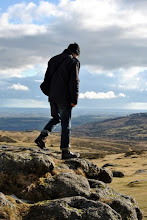
On announcing my intentions to take a weekend break in Dartmoor recently I expected the usual, "Dartmoor, how lovely", comments that usually accompany any mention of any trip to anywhere no matter the relative loveliness, or not, of said destination. Not so this time, "Dartmoor! in February? Good luck!". "No, no", I say, "we always have good weather for holidays. It will be fine". Maybe they had a point I thought, trees don't grow on Dartmoor for a reason (more on this later). But it was not these weather related and possibly sound fears that shook my confidence in a late winter trip to the highest moor in southern England. No, it was a quiet comment along the lines of, "Dartmoor! I've never really seen the attraction of it. People say it's beautiful, but I just don't see it." Well this took me aback and got me thinking about bigger questions on what it is that people 'see' in a landscape. As a landscape designer I often fear that too many people do not not really 'see' their surroundings at all, especially in urban areas. In Dartmoor you cannot help, but 'see' the landscape. Grand new vistas leap up at you around each bend and over every hill, each one as arresting as the last. Great granite tors tearing through the earth atop their smooth boggy hills. Ancient settlements and stone circles litter the area while the man made leats still carry clear water across the moor, often appearing to defy gravity.
Personally I can not help but fall for this spectral place, despite the lack of trees (more on this later). I have heard that in times past Ladies would close their carriage's curtains to hide the craggy hideousness of mountains and hills when travel forced them through such places. Such ideas seem completely foreign to us now since romantic poets and travellers have given us a new way to see the natural world. But do such ideas still exist in ways we shall not understand for generations? Will our poorest cityscape's or nuclear power plants seem more beautiful to our great grandchildren than they do to us? Beauty is in the EOTB of course, but the finding of beauty (or not?) in a landscape reveals much more of the beholder, than might be imagined. Dartmoor is not a safe or comfortable landscape to look at. It can be cold and bleak, and looks it too. This could be unsettling for some people, just as forests, and therefore trees, may signify darkness and beasts to others. Understanding the emotional reaction that people have to their surrounding is key to designing the right space for them. Asking a client where they feel most comfortable may be a better question than 'what colour flowers do you like' or 'what's your favourite tree?' Get the psychology right and the garden will follow.
More on trees (or lack of) next week.